How the charts work
For readers and authorsUpdated 2 min read
The Charts rank books by real reading activity each month (readers, finishes, saves, reviews, weighted by a rating that needs many ratings to move), never by sales or anything an author can buy; a book needs three engaged readers in a month to appear.
The short answer
What a chart is
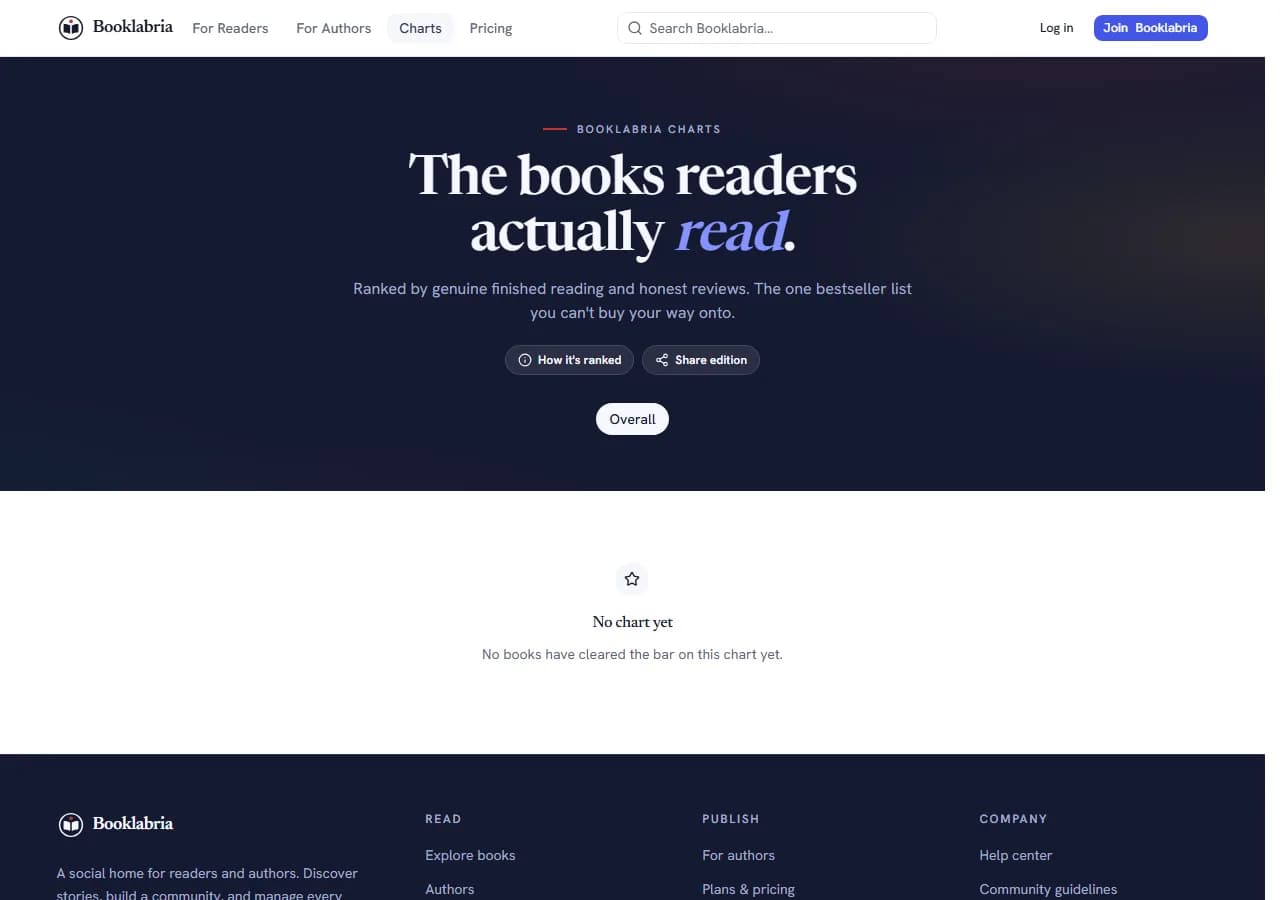
The Charts page shows, for each month (an edition), which books people here actually read: an overall chart and one per genre, with the month's top three set out, the rest in order, and the genre leaders beside them. Anyone can read it, signed in or not: signed out, Charts is in the top bar; signed in, reach it from the footer's Read column or from Home's side rail. Pick an earlier month to see that edition.
What counts
For each month, every published book is scored from the engaged activity of readers other than its author:
- readers who marked it Reading, updated progress, finished it, or downloaded it as an early copy (weight 1 each),
- finishes (weight 2),
- saves: the book added to any shelf that month (weight 0.5),
- reviews written that month (weight 3),
multiplied by a quality factor built from the book's rating. The rating is a Bayesian average: it starts at 3.8 and needs many real ratings to move, so a book with two five-star reviews does not outrank a book a hundred people finished.
Nothing an author can buy counts: no sales, no ads, no boosts. Profile visits and post views never count anywhere.
The eligibility floor
A book must reach three distinct engaged readers in the month to chart at all. A brand-new book with one devoted reader is not on the chart yet, and the page says so rather than showing a chart of one.
When it changes
An edition is refreshed on a schedule by the platform (readers do not trigger it); movement since the last refresh is shown beside each entry. Authors are told when a book of theirs moves, if they keep that alert on (Following and notifications). A month at the top earns its author an achievement (How achievements work).
Where this lives
Related
- Finding books: Search from the header, browse Books and Authors with filters, let Discover recommend, reach the wider catalog for books not published here, or import a Goodreads or StoryGraph export.
- Understanding your Readers page: Studio, Readers answers one question per tab in plain words: Overview (followers, monthly readers, monthly reach), Followers (recent followers and the tastes they chose to make public), Mailing list (your email list and its export history), Journal, Books, Early copies (the campaign funnel) and Letters. Aggregated nightly; no sales figures, nothing faked.
- How achievements work: Achievements are illustrated marks for things you actually did here. Finishing books, turning up to Circle meetings, charting. Only the ones you have earned are shown, newest first, on your profile; each opens to say when and for what.
- Writing reviews: A review is a star rating (press a star for a whole one, or use Exact rating for any quarter step) with an optional title and a body of at least 20 characters, plus a spoiler flag; edit or delete it from the book page. You can also say how the book felt, up to three moods and a pace; the book's page shows what most readers found once five have said. Reviews of early copies carry the early reader badge and one extra rule, honesty.
Was this helpful?
Still stuck?
Still stuck? Ask Booklabria AI
It reads this article and the ones around it, and cites its source.
Write to a person
Support reads every note, with this article attached so the team knows what you already read.
Contact support